The craze started at the release of iPhone1 in June 2007. I remember watching the live stream on Mogulus, predecesor to livestream.com, it was filmed and broadcast by Max Haost, founder of livestream.com and they were extremely hilarious in the way they would actually make fun of the people standing in line. I find this unbelievably hilarious, it’s the extreme example of the gadget-craze (out-of-control gadget consumerism?)
The ipad 2 line in Houston, TX as reported by Engadget.
Blame the analysts, unless they see lines, they think Apple isn’t selling any products.
This launch was engineered to generate lines (no pre-orders, 3 week waits if ordered on line…) and lots of free publicity…
the scarcity principle is the mother of all marketing techniques (…) We generally perceive that things that are difficult to get are typically better than things that are easily available. If everyone wants it then it must be good right? This actually taps into the principle called social proof
Queuing up for a piece of gadget is a really weird concept. In theory, especially for Apple, those devices are mass produced in gigantic proportions in the biggest Chinese factories, somehow Apple would not be able to manufacture enough to sell to whomever would want one?
This whole lining up deal is a situation designed by Apple’s viral marketing department.
This carefully choreographed gadget marketing/pricing ballet has turned Apple into the second largest company in the world, just 3 and a half years after the release of the iPhone. It’s really insane if you think about it. If not for the largest oil company in the world Exxon Mobile, Apple would be the largest company in the world, and most of Apple’s current profits and revenues come from their ARM Powered iOS devices, especially the iPhone.
So now Apple is doing a big push on the tablet market with iPad. And the iPad2 certainly has a nice Dual-core ARM Cortex-A9 processor in there.
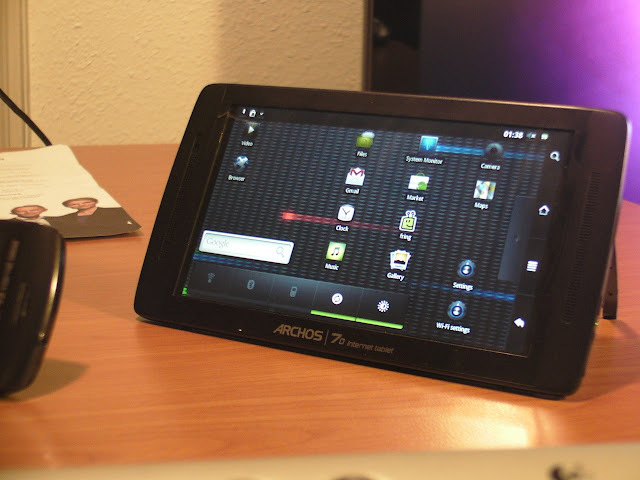
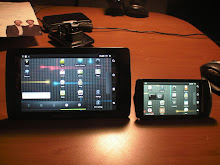
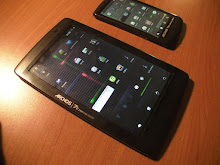
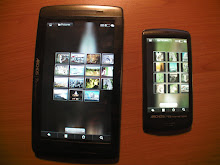
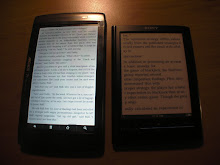
There are Android tablets like Archos 101 Internet Tablet released 6 months ago, that are lighter at 480gr vs 600gr, that have real mini-HDMI outputs built-in, real USB-host built-in, a real kick-stand built-in, and that still support more video and audio codecs (such as all DivX, MKV found on BitTorrents), with Flash support, real multi-tasking for 40% to 60% cheaper price than the ipad2.
In my opinion, Honeycomb is the first real Tablet OS. And I am pretty sure Honeycomb tablets will overtake iPad market share in less than a year, faster than Android overtook iPhone after the Nexus One release.
For some engineering resource/time allocation/prioritisation issues, Google chose not to allow much to happen with tablets with Donut, Eclair, Froyo and Gingerbread. Companies like Archos were left with the open source part of Android, doing the customizations they want, but for some strategic reason, they were left without the full support from Google. Google didn’t want Android Powered iPad and iPod Touch competitors to dominate the market in 2010. They thought they perhaps were busy enough dominating smartphone growth of that year, and gaining the full support by two dozen Smartphone makers in the process.
I think Google’s strategy is to simply let the Apple viral marketing people do their thing first, then get their better open and free software in gear, and riding on Apple’s viral marketing coat-tails, Google’s Android ecosystem can then provide the big push and rapidly dominate.
This is also a dance of technological disruption, and disruption of those disruptors. Google can’t be seen as encouraging the industrys too rapid change, while some companies bet their futures on the Open Handset Alliance, Google had to be careful and let the market move as fast as it can without hurting the feelings of the big partners who invest billions of dollars in this and want to see their investments safely recouped.
In any ways, look forward to the Android Honeycomb ecosystem taking care of making Android the top platform for tablets fast, and look forward to new designs to make tablets even more fun, more productive, and basically turn these gadgets into the user interface of the future of mobile computing for all the people of the world.
Starting tomorrow, I will be posting here upwards 50 videos of the best ARM powered devices to be shown at this CeBIT Hannover Germany, one of the worlds biggest consumer electronics trade shows. This is my 8th consecutive CeBIT doing video-blogging. Yup, I started video-blogging from consumer electronics trade shows at CeBIT 2004 (you can see my CeBIT video archive for 2004-2009 at techvideoblog.com). If you have any tips you can write them here in the comments, click on Submit News at any time, or send them to my email charbax@gmail.com
Here are some of the topics that I expect to find at this show:
1. Chrome OS devices, does Google find it appropriate to let the laptop and desktop makers start to display ARM Powered Chrome OS laptops and similar devices? Recently it has been leaked that the ARM cortex-A8 i.MX51/53 Powered Acer DXH241 monitor will come with built-in Chrome OS, letting all monitor makers add Chrome OS for below $50 in ARM Powered component costs. Though it is also likely that Google may want to delay Chrome OS devices release a few more months and do some kind of big Chrome OS device unveiling at some other event.
2. Is it time for the International ARM Powered Google TV unveiling yet? Samsung usually has gigantic booths at CeBIT, will they show their Exynos ARM Cortex-A9 Powered Google TV there already? Because of the international media rights issues, and Google’s issues with getting TV rights within the US market even, it may be Google waits for Google I/O in May or so to unveil more on that.
3. Anyone to launch Honeycomb, Chrome OS and Ubuntu compliant ARM Powered laptops, as nice or nicer even as the Toshiba AC100 (which recently got the Froyo upgrade)? Tegra2 is getting very popular, and other Cortex-A9 platforms are ramping up traction, as all major laptop makers have big booths at CeBIT, I will be looking for them showing off ARM Powered laptops.
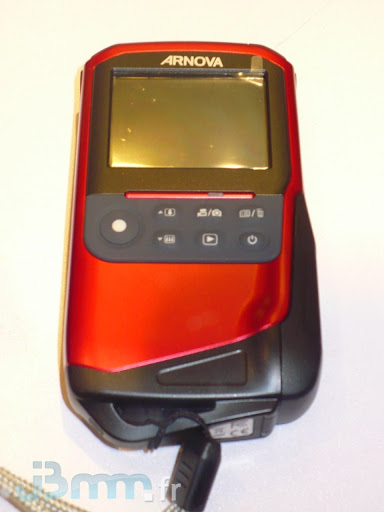
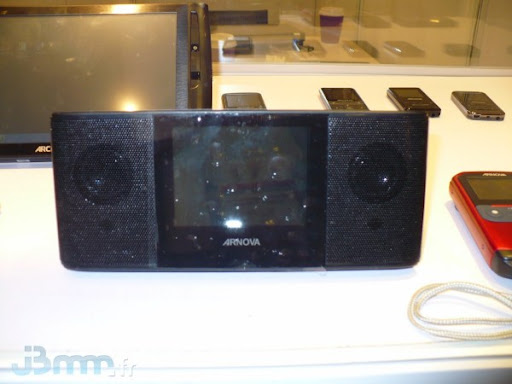
4. More and better Android tablets. I will be bringing you videos on all the best new Android tablets, including filming the news from the Archos booth where I think that they will show more than the Arnova 10 and Arnova 8 that I just recently filmed.
5. I’m hopeful Panasonic will unveil a new compact HD camcorder to be the equivalent to a Sanyo HD3000 with better optics, better compression, WiFi/Bluetooth features and more, because I’d like to upgrade my camcorder to something like that. Panasonic recently unveiled camcorder designs similar to the Sanyo Xacti.
Here is a world exclusive video unveiling of the new Arnova 10 entry-level 10.1” Android tablet:
This may become the world’s cheapest ARM Cortex-A8 1Ghz RK2918, 10.1” capacitive Android tablet on the market (I filmed an early pre-production prototype of it with capacitive/rk29 combo at CES here). Until about April, Arnova 10 is released now as a 10.1” resistive ARM9 600Mhz RK2818 tablet. The price remains $199 in the USA, 199€ in Europe (consider all European prices always include ~20% VAT). Look for a slightly different model number once the capacitive/rk29 version starts shipping. They will shift to it as soon as 10.1” capacitive and rk29 components are ready/stable and mass manufactured, the Chinese suppliers are working as fast as they can, this should be in a couple months.
Archos is the second largest tablet maker in France according to GfK sales numbers, having 22% market share, far in front of Samsung with 4%, 67% for iPad. Arnova is a new brand from Archos based in Hong Kong, that uses the design, manufacturing and distribution strengths of Archos but will remain a separate brand for the cheaper $100-$200 Rockchip based devices (see the press release here). The idea here is to get these excellent valued Rockchip based designs to more people in Europe and the USA. But Arnova is also more extensively going to be promoted for developing countries as people there enjoy cheaper stuff. But people enjoy cheaper stuff everywhere.
Rockchip is doing excellent work optimizing cost in their entry level SoC designs, and are doing stable hardware optimizations with the latest versions of Android that can be adapted for the given ARM architectures that they use. Archos has probably been the top selling Rockchip maker thus far with the Archos 7 Home Tablet massively sold in every major electronics store in the USA and Europe these past 12 months (go check your local Staples, Best Buy, etc.. it’s probably there), and they plan to further extend that kind of reach with their new Arnova branding.
As it stands right now with Rockchip, Eclair is the furthest they can go for ARM9 RK2818 based devices (Donut for their older ARM9 RK2808 without graphics acceleration), and Gingerbread is the furthest they can go with ARM Cortex-A8 RK2918 based devices. But who knows, Google may announce tomorrow Honeycomb support for every popular ARM architecture used in any previously certified or not certified Android tablets out there, even including the cheapest Rockchip designs. I asked some Google people at MWC, including in my interview with Honeycomb designer Matias Duarte, they told me Honeycomb has no minimum hardware requirements, which hopefully also means other than opening Honeycomb source code for all to use, that Google will also allow for Google Marketplace on all devices without requiring stuff like compass/gps/3g, and hopefully Google also plans to dedicate resources to help all SoC platform makers and device maker with getting great and fully hardware optimized new firmwares with Honeycomb and Marketplaces onto all these cheaper devices as well (evt with Holographic UI effects disabled on low hardware specs).
$800 for a Honeycomb tablet is a lot of money for some people. Sure enough, the Dual-core ARM Cortex-A9 Tegra2 Honeycomb experience is awesome, but a lot of people prefer paying 4x less if they can get a decent ARM Cortex-A8 Honeycomb experience, if Google and companies like Arnova just allow consumers to have that choice.
Specs:
Price: $199 in USA, 199€ in Europe (consider all European prices always include ~20% VAT)
Capacity: 4GB (or 8GB) with MicroSD slot
OS: Android 2.1 Eclair (on RK2818), Gingerbread (on RK2918 version available ~April), Honeycomb? (depends on Google/Rockchip)
Display: 10.1″ 1024×600 touch screen (resistive now, capacitive version available ~April) , 16 million colors
Video playback (on current RK2818 model): H264 up to 720p 30fps 5mbitps, Mpeg4 30fps 2.5mbitps, RMVB up to 720p 30fps 2.5mbitps, in these extensions: .avi, .mp4, .mkv, .mov, .flv (RK2918 version available ~April may add 1080p and higher bitrates support)
Audio playback: mp3, wav, ape, ogg, flac
Photo: jpeg, bmp, gif, png
Interfaces: USB 2.0 Slave MSC, USB 2.0 Host MSC, MicroSD slot
Wireless: WiFi b/g
Other: built-in speaker, microphone, G-sensor, front-facing VGA camera
Battery runtime: TBC music, up to 6h video
Size: 272×152.3×13.5mm (10.7″x6″x0.5″)
Weight: 570gr (20.1oz)
I filmed and posted 75 videos from this years Mobile World Congress, I hope you enjoy watching some of those! Here are the highlights, the best topics of this show, making this possibly the most awesome trade show ever for ARM devices!
These are some of the cheap unsubsidized prices (boxed in store, no contracts needed, excluding reseller margins) for the cheapest Android Smartphone ARM SoC platforms that were shown last week at this Mobile World Congress:
Taiwan based:
- MediaTek at less than $100
- Infomax Communication at $80-90
China based:
- Leadcore Technology at $80-105
- Fuzhou Rockchip Electronics at $90-105 (I filmed Rockchip at CES)
US based:
- Qualcomm MSM7227 ARM11 ships in the largest amount of cheap 3G Android phones that are about to sell for as low as $100-120
- Broadcom is planning such solutions also to be priced at $100-120
The Cheap Android Smartphone revolution is a HUGE deal, it means a Billion more people might afford to get Internet access and mobile personal Internet features in the next couple of years or so. And this means a potential HUGE disruption of the carrier/manufacturer Smartphone industry, as more and more European and US consumers are going to choose Sub-$100 Android phones without the need for 2-year contracts anymore, those phones can be used on pre-paid and even using unlimited free VOIP over 3G or LTE data-only services pretty soon.
2. Honeycomb, the first real Tablet OS
- Samsung Galaxy Tab 10.1
- Motorola Xoom (Xoom at CES)
- LG Optimus Pad
- Malata’s upgraded Tegra2 tablets (designs used by ViewSonic, Interpad, Hannspree etc..)
- My Interview with Honeycomb Chief Designer Matias Duarte: He confirms Honeycomb has no minimum hardware requirements, this means, ALL ANDROID TABLETS, even ARM Cortex-A8, even all existing Archos, Samsung, Dell tablets, even 256MB RAM, even the cheaper Rockchip 2808 and 2818, even Telechips, all may be getting Honeycomb firmware upgrades. It’s certainly an important detail to find out how much Google engineers are planning to be involved reaching out to each of these lower cost ARM SoC platform providers in porting the Honeycomb to all these cheaper and already released Android tablets platforms once the Tegra2 devices are out, the source code and the UPGRADED CDD (Android 3.0 Compatibility Definition Document) is instantly released. Honeycomb Holographic UI elements might be disabled on cheaper hardware that have less processor, memory and graphics acceleration. This should happen and get fully explained by Google Engineers within a few days! Honeycomb is not only for $800 tablets.
Froyo for current Android tablets is just as good as iOS on iPad. Since Donut SDK are Android apps supporting medium density screens (= tablets). Honeycomb is simply the first time a high-end ARM Powered tablet OS has really been designed and optimized for tablet use. Playbook and WebOS may look nice and similar, but they have no ecosystem (nobody can compete with open and free), I expect HP and RIM will be forced to simply use and build on Android within months.
I got this confirmed from a source at Google (to remain anonymous) that Honeycomb will likely work just fine on all the cheaper tablets, such as the ARM Cortex-A8 ones like Archos and even the super cheap ones with Rockchip ARM9 or Telechips ARM11 processors. We’re all set for disruptive Android Tablet future with no need to be member of a “high-end special club” to get Honeycomb and especially to be allowed the Google Marketplace and all Google Apps. Google are to update the compatibility guidelines for devices to be Google Marketplace compatible and they “simply” add more filters to prevent consumer confusion.
I’ll try to get this confirmed and explained on video by some Google representatives during the Mobile World Congress.
“Hacking away with Android” on Beyond The Keyboard takes a look at Android tablets, what they can do, what they are not yet capable of and what they should do in their opinion.
It has several nice and colorful graphics to compare and show the positioning, differences, gaps, possibilities and shortcomings of tablets in general and tablets compared with each other.
One of the “problems” with Android identified is the lack of hardware drivers for printers and scanners and the lack of support for multiple external drives.
Tablets brands compared are: Archos, Dell, Samsung and Creative. The iPad 1 is – due to its impact on the tablet market – added as a reference.
Alcatel One Touch is one of the makers of cheap Android Smartphones such as the Alcatel OT-980 which is sold for only £99 on pre-paid plans in the UK. Alcatel One Touch is a brand of TCL Corporation, a $16.7 Billion valued Chinese consumer electronics company.
Alcatel One Touch’s partnership with Archos would enable an easy sharing of data from a low cost Android Smartphone using a ‘’One Touch Connect’’ button to share the 3G data automatically with the Archos tablet over a mobile WiFi hotspot. This may be a one-click process, and the carrier may be able to limit access of that WiFi hotspot only to the Archos tablet through Mac address filtering and not as a totally open or encrypted WiFi hotspot for use with other devices.
The idea is that one affordable subscription plan include the voice and data through the low cost Android smartphone as well as the low cost yet high-end Android tablet. This way, consumers don’t need to subscribe to more than one package. I think it can be expected that Alcatel One Touch will present a new range of cheap Android Smartphones at Mobile World Congress next week with this One Touch Connect mobile hotspot functionality built-in.
Here is expectation/guess/suggestion for a pricing model which I think would make this kind of offer a sure hit:
Pre-paid only, no contract: $299 for the basic 3.5″ capacitive Alcatel-OT Smartphone and the latest Archos 7″ capacitive tablet, both are on pre-paid and no contracts are needed, pricing for pre-paid should be below $30 per month for something like 300 minutes or unlimited use of voice and 3GB to 5GB of data per month to be used on the Tablet and the Smartphone. The 3GB monthly data hotspot may be open for other devices as well if the carrier wants to allow it. For example $10 to $20 extra per month it could open up the mobile hotspot to any other device and increase monthly limit to something like 10GB per month.
Phone alone on pre-paid no contract should be $149. Tablet alone no contract needed would be $249.
6-month contract, then pre-pay: $249 for the Smartphone+Tablet package, $30/month for unlimited voice/data to use on both devices or more. $50 early termination fee, lowered $5 each month.
12-month contract, then pre-pay: $199 for the Smartphone+Tablet package, $30/month for unlimited voice/data to use on both devices or more. $100 early termination fee, lowered $5 each month.
18-month contract, then pre-pay: $149 for the Smartphone+Tablet package, $30/month for unlimited voice/data to use on both devices or more, $150 early termination fee, lowered $5 each month.
24-month contract, then pre-pay: $99 for the Smartphone+Tablet package, $30/month for unlimited voice/data to use on both devices or more. $200 early termination fee, lowered $5 each month.
What do you think of the idea to use a cheap Smartphone mostly for voice and basic apps and tether it with a larger screen Tablet, use all on one same low cost voice+data plan, and even have this work for pre-paid plans?
According to French market analyst GfK, Archos is now the second biggest tablet maker on the French market, far in front of Samsung (4%), Toshiba (3%), Huawei, Viewsonic and others. Sure enough Apple has the biggest market share with 67%, but I think that’s mostly due to Apple having more cash for manufacturing and distribution. If Archos had been able to spend more money producing more units and having better stock availability at all resellers and never run out of stock during these past 3 months, then I think Archos would probably be number 1 in market share, even in front of Apple.
As I run the biggest Archos fansite community at http://forum.archosfans.com and I have been publishing the earliest and most popular video reviews of Archos products for over 6 years, publishing the earliest and most popular videos of Archos full Tablet line such as the 70 Internet Tablet, 7 Home Tablet, 101 Internet Tablet, 32 Internet Tablet, 43 Internet Tablet, I may be biased. But I am sure that if all stores had enough Archos in stock to satisfy the demand for tablets over these past 3 months, Archos would sell even more than Apple.
What matters to the consumer is the value proposition. What features they can get for what price. Archos newest Gen8 Android tablets are about half the price of the iPad and provide more features.
The smartphone OS wars are not about functionality or design, they are about the business model. Consumers or tech blog reviewers don’t get to chose which smartphone OS wins and looses.
Today, the carriers decide
The main reason Android dominates today is that carriers pay about $200 less per customer on an Android phone compared to an iPhone (about $400 vs $600). The other aspect of Android that carriers like is the customization of it to make more money on extra services. For example, Google provides the carrier with a share from app sales in the Google Marketplace. Carriers can pre-load the devices with apps for on-demand music and videos and other services. Apple does not give carriers any share of revenues from the App Store or iTunes.
The actual bill of materials and manufacturing cost of today’s high end Android smartphone or iPhone is less than $150. Amazingly, the average US smartphone consumer pays above $2400 for his smartphone on contracts, for example, Verizon’s Average Revenue Per User is $105/month. ARPU is lower in Europe, and much lower in developing countries. The carrier economic aspect of Android winning is only how things are today. Even as there is competition with very good high end Android smart phones provided to the market by Samsung, Motorola and HTC, consumers still pay about the same for these phones as they would with an iPhone.
When the carriers loose control
Things are going to change fast. Soon, the carriers will loose control of the smartphone market, and Android will dominate even more.
As 20 Android smart phone makers compete, there are to be $99 Android phones sold unlocked directly to consumers, such as the Chinese Huawei or ZTE Android phones, there will be alternatives to carriers voice services such as the new VOIP centric version of Google Voice which has become an integral part of Android in Gingerbread.
The next phase of Android means consumers will have choices such as the Archos 28 Internet Tablet at $99, no contracts needed, to do SIP/VOIP/Skype calls on WiFi-only, and depending on the region of the world, there are sub-$20/month even sub-$10/month data SIM cards that will be used to get Data-only experiences of Android. White Spaces could also provide for worldwide free wireless broadband for these devices if setup using the http://fon.com model.
While bloggers analyze smartphone differentiation, fueling a feature war on blogs among constantly improving Android super phone specs, in which new models are represented as destroyers of the ones released the previous week, the fact is brands that sell most don’t do it on features, they do it by negotiating the strongest deals with the carriers. If you look at the US smartphone market, it really doesn’t matter which high end Android phone consumers buy, they all cost basically the same $2400+ after those compulsory 2-years in contracts. The consumer only really gets a choice once devices are sold unlocked through all retailers. Then, prices for these devices will have a meaning and the best value for feature will clearly win. So if you thought it was fun with all these Android phones coming out through carriers this past year, you haven’t seen nothing yet compared to what will happen once phones are sold unlocked directly to consumers.
The next billion sub-$100 Android smartphones
Android smartphones can thus soon be $100 unlocked instead of $2400+ on contract. We are talking about a 24x cheaper Android experiences for the consumer. At that point, the consumer gets to choose who wins the smartphone war. This is happenning. It doesn’t matter what Apple, Microsoft, RIM, Nokia and others do. When there are $100 Android phones in every super market, competitors don’t get to keep a market share if they don’t also provide the devices unlocked for $100 with no contracts needed. You think Apple is looking forward to loosing their 300% profit margins on the iPhone?
What carriers will do to try to keep control
The only ways carriers will try to retain control on their trillion dollar industry will be to block VOIP on cheap wireless data plans, buy out and close down any pre-paid carrier competitors that are offering services that are too cheap on any given market, campaign against unlicensed use of the 700Mhz spectrum for White Spaces, block the licensing of 3G/4G modem technologies in cheap unlocked devices, do anything they can to limit competition in the wireless carrier business. Hopefully all these attempts at keeping control will be defeated by strict regulation and government policies.
The smartphone industry is moving too fast for any Government to regulate it, much too fast even for carriers to adjust and protect themselves against the auto-disruption that is inevitable. Everyone is racing and trying to keep the flow of money going their way for as long as possible.
[I originally wrote this on 16th December 2010 to be published on another blog, but since it wouldn't get published there as is, I decided to post it here, your turn to say what you think in the comments.]
Larry Page is the new CEO, here’s what I think Google should do.
1. Make White Spaces happen. Things are moving far too slowly. I want to see White Spaces deployed to provide free wireless broadband to the whole world as an alternative to the proprietary 3G/4G/LTE networks. It should be deployed using the FON.com model, Google can invest meager $50 million or whatever is necessary to mass produce the first 1 million routers to activate White Spaces sharing all over the world. The idea should be this, users get these routers that may initially cost $50 to manufacture because the White Spaces chipset is new, but could eventually cost below $20 per router. They install it in their homes, connected to whatever ADSL, Cable, Fiber that people already have in the home. This router creates a White Spaces hotspot that reaches much further than within their home, to cover their whole neighborhood with bandwidth. The router is clever in that it can dynamically throttle bandwidth, if you are at home and you need to use your own bandwidth your bandwidth is 100% prioritized for you to use, thus it does not feel at all like you are sharing your bandwidth, that bandwidth sharing is only of the bandwidth which you don’t need yourself. The whole global network uses OpenID and such with increased level of verification of every users real ID, to authenticate each user on that network, so this is not used as an untraceable anonymous global Internet access, but where any illegal activity could be traced back by local authorities if needed (obviously, proxies and encryption can always be used if someone really wants to be anonymous).
Listen to Larry Page talk about White Spaces, this is more than 2 years ago. What has happened since?
2. Open Google Marketplace to all devices. If there is one point where I think Google might be evil, it’s in their policies to hamper innovation with Android. It’s been about a year and a half that Archos has put Android tablets on the market, still they are not allowed by Google to install the full Google Marketplace on the device. Google needs to stop now. Open several versions of the Google Marketplace if they want, for different types of devices. Or basically just add a settings menu in Google Marketplace that allows apps to be filtered and highlighted differently in terms of how they have been tested (mostly by users themselves) to work better or worse on every different type of device. Allow in those settings for the user or device to present itself automatically for example “without 3G”, “without compass”, “without back camera”, “without android buttons”, “at this specific screen resolution”, then filter apps from there, but never block access to all apps on all devices, if some apps don’t work correctly on certain class of devices, so be it. I believe 99% of the 200’000 apps in the Google Marketplace work 100% just fine on about 100% of the cheapest Android tablets on the market.
I understand that Honeycomb should be opening up Marketplace for more devices. For tablets it’s kind of a certain. But still, will Google allow even the cheapest ARM9 Tablets full access to Honeycomb OS and Marketplace? Honeycomb for Laptops is a possibility. Honeycomb for e-ink e-readers, maybe.
In any case, it’s kind of sad that it took Google more than 2 years to open up Google Marketplace for more devices. This has let Apple all alone in the market of iPad and iPod Touch.
3. Campaign for Net Neutrality on wireless networks for VOIP access. There has been a lot of rage on the blogosphere about Google’s partnership with Verizon in the USA leading up to a Net Neutrality proposal that exempted wireless networks.
It is understandable that bandwidth on wireless networks such as 3G, 4G and LTE have to be managed because it only takes a few users to download some BitTorrents at full speed on one base station for a whole area of up to 1km in diameter where users might experience dropped calls and the like. As far as I understand, even for LTE, bandwidth is limited, although it could be argued that carriers should then just build more base stations closer to users, if they do spend significant money to expand their networks or not, it’s understandable that wireless networks need to be throttled somehow.
But, that should absolutely not allow carriers to block voice-over-IP usage. That is pure evil. Wireless bandwidth shall be used HOWEVER the user wants to use it. If carriers don’t like the idea of becoming dumb pipes of data, that is their problem. They should have considered that possibility when they decided to become carriers.
Carriers have made enough trillions of dollars of profit already, not for them to justify that they should be allowed to continue to gouge the consumer of thousands of dollars per year in completely data bandwidth prices. When you consider the price of 1MB of SMS messages sent costs about $10’000 to the consumer. We are in the year 2011, 1MB of wireless data SHALL NOT cost $10’000 to the consumer.
4. Destroy Facebook, Twitter, Groupon, Foursquare and other over-hyped social networks and location based services. This is a call from a user who gets tired of these boring, unoptimized, wastefull, meaningless excuses for social networking and location based services. What a waste of time! Google has to fix this now!
Twitter only benefits famous people. That’s why they keep talking about it. For 99% of users, twitter is absolutely useless, for anything else than to follow whichever famous person you like following, in lists of garbled, meaningless, unoptimized, spammy, messy 140-character messages. Make it stop, please.
Facebook is the newer type of Myspace that is a trend in high schools globally. It’s for not much more than grouping school kids together and have them waste time on farmville, a tool for massive stalking of a bunch of people you never spoke to for 10 years or more. Make it stop, please.
Social networking will be extremely useful eventually. Location based services will revolutionize everything that we do. Just not in those forms. Google needs to make a social network with location services in a way that absolutely makes sense. Make it so people get to do constructive things in the world, people move more, do more things, people get to be more productive, meet more people. End the global era of wasted opportunities, wasted efforts, mutual disdain, rejection and loneliness that can be felt by everyone.
Social networking that makes sense changes organizations, it changes companies, it changes communities, it changes countries. It auto-regulates humans use of global resources and actually makes democracy work.
Yeah those may be high hopes for Google’s social network, but who else than a company of the worlds top 24 thousand Phd software engineers can we rely upon to make this work?
5. Merge Android, Chrome OS and Google TV into one ARM Powered software platform. Google needs to focus on bringing the full Chrome browser on top of Android, provide it with full Google TV features, make it all boot on one ultra optimized ARM Powered software OS image. Read my previous post “Recipe for the ultimate ARM Powered device” for more on how this all-in-one software should work.
6. Bring Internet access to the next billion people faster. It’s all good how Android is taking over the smartphone market. It eventually does bring cheaper Android devices mostly made by Chinese vendors themselves. Still it is not going fast enough. Google should make it a priority that a $50 Unlocked Android Phones shall become available globally. Google should invest billions of dollars in One Laptop Per Child, have it run open source software that is supported by millions of people. Reaching the $75 Tablet should be a priority. Invest billions of dollars in Pixel Qi to mass produce their screens as fast as possible, make sure all devices can last 10 times longer on a battery as soon as possible.
The thing is western countries have a lot of electrical power so they don’t care enough about not having to recharge a 2300mAh battery every night. Consumers in wester countries don’t care enough about the price of the smartphone as most are still buying smartphones subsidized by a carrier who charges upwards $3000 in 2-year contracts that for example most Americans feel are natural thing to sign up for when getting a smartphone.
Getting mobile computing to the next billion people within 2-3 years should be a priority for Google, and if that risks to disrupt the actual business models of the carriers in developed countries by the availability of $50 unlocked Super Phones, $75 Tablet/E-readers and $100 Laptops in every super market, so be it.
7. Monetize independent web video production and make VOD the worldwide standard through YouTube and Google TV. YouTube has already become the worlds largest bandwidth infrastructure, streaming out more than 2 billion video streams per day, hosting and encoding all the worlds video, it’s impressive. Yet, Google now has the opportunity to reach much further and completely monetize YouTube. The YouTube Partnership system is a drop in the bucket compared to what they should do. I’m not allowed to become a YouTube Partner even though I have over 12 million video views (including what I put on other channels and what I had put on Google Video), the reason being Google only allowes residents of G20 countries access to even apply to become a YouTube Partner.
Of those that are conservatively monetizing YouTube video views with overlay advertising, they could do so much more. Why not provide a one-click donation button under every video, on every channel page to allow viewers to sponsor the future productions of their favorite content creators? Why not embed price comparison links with commission payments on one-click sales under every video that talks about a product that can be bought by interested viewers? Why doesn’t Google provide a global subscription plan à la Hulu, but where it gives access to much more than just established Hollywood/TV contents, but where it also monetizes ads-free or higher definition viewing of all independent content? Why doesn’t YouTube offer pay-per-view solutions worldwide, for example, let viewers choose to pay very small amount of money to get a direct link to download any of the videos as an uncompressed video file or on-demand encoded to chosen codec and bitrate/resolutions?
YouTube needs to become much more than the worlds biggest bandwidth infrastructure project. YouTube has to become Google’s biggest source of revenues and profits. It needs to become a tool that changes media and ultimately that improves democracy.
What do you think Google should do now that they have a new CEO? Post in the comments.