Linutop sells small, silent and low power PCs based on AMD Geode and VIA C7 processors to use in business and industrial environments. Now they are launching Linutop OS 4.0 that anyone can download at http://www.linutop.com/software/download.en.html to boot from a USB stick or CD/DVD on any x86 computer. They are also considering providing this solution for ARM Powered desktop systems as soon as several popular low-cost designs are released. This video features Linutop founder and CEO Frederic Baille talking about Linutop and a screencast to show the principal features of this OS.
Category: Exclusive videos
7″ Android Tablets are awesome
Steve Jobs is saying that 7 inch Android Tablets can’t be popular. I think they can. This Archos 70 Internet Tablet fits in most Jacket Pockets and thus is the largest screen size that can be carried around without using a bag. Also, this one is half the price/size/weight of the iPad, it comes with HDMI output, full video/audio codecs support, USB host and a built-in Webcam for video-chat all which iPad lacks. This tablet at 300gr and 201x114x10mm may be the lightest and most compact 7″ tablet yet, but I think with optimizations and designs that use less bezel, the weight and size could further be optimized to make it even more jacket pocketable. Basically, Android tablets will provide choice for consumers, from small pocketable ones to larger ones that may mostly stay at home.
Review: Archos 70 Internet Tablet (part 2)
Posted by – October 19, 2010
Testing some cool features, Dolphin Browser HD multi-tabs, video-chatting, RDP, video-games, I just did a 37 minute VOIP call using SIP on Fring and using my $8/month 1GB/month SIM card in my Huawei Mifi and it works pretty much perfectly. For some reason audio in Skype and in Fring video-chat is still buggy, but I am sure Archos will fix this in a firmware update imminently. Also see Part 1 of my video review of this product.
Review: Sony Reader PRS-650 Touch Edition
Posted by – October 18, 2010
It has a nice screen, I show it, and I give you my opinions on this e-reader. Sony is bringing a really nice E-ink Pearl based e-reader with a fantastic very sensitive infrared based touch screen. Though I wish it had WiFi and Android software for Chrome-to-Ereader functionality and Sharing and Synchronizing of Annotations and Reading to make Annotations and Reading more useful. It’s cool that Sony promote the “get unlimited ebooks for free from your digital library” concept. With WiFi, though, the integration with unlimited amounts of ebook repositories would be more seamless and probably more user friendly. If all you are looking for is an offline e-reader, with the latest e-ink screen technology, with touch-screen for page turns, dictionary/translator and for annotations and UIs, then this could be a great choice for you.
Also see my Grandmother reviewing this device in my video released last week and my 11-minute video interview with a Sony specialist unveiling it and discussing technical details about it at IFA.
Related articles
- Exclusive: Sony PRS-650 Grandmother Review (armdevices.net)
- Review: Sony Reader Pocket Edition PRS-350SC (macworld.com)
- Sony Reader Pocket Edition (PRS-350SC) review (engadget.com)

Archos 70 Internet Tablet Review
Posted by – October 16, 2010
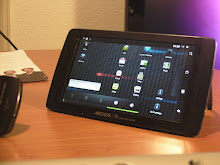
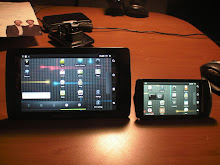
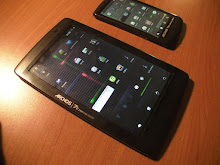
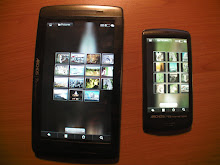
First unboxing and review of the Archos 70 Internet Tablet, a $275 alternative to the $499 iPad and the $599 Samsung Galaxy Tab. I was amazed by how thin and light it is when I first took it out of the box, at 300 grams, it nearly feels like it’s an empty case without any electronics inside.
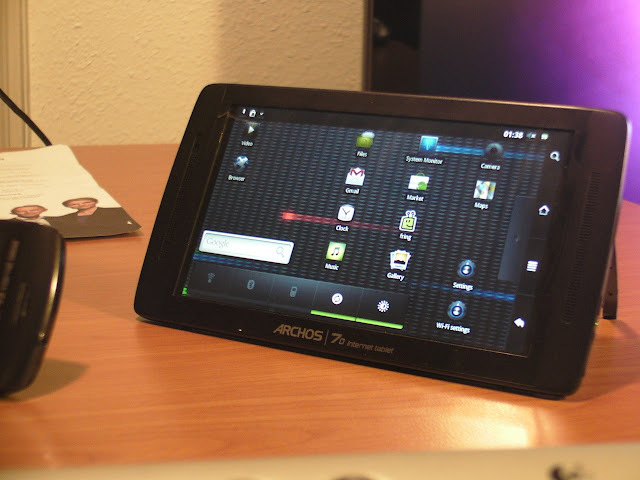
The capacitive touch screen on an Archos tablet is cool, I need to get used to that. Hopefully I will learn to type on it as fast as I do with my finger-tips/nails on my resistive screens. My plan this winter is to carry this 7″ Archos Android tablet with me everywhere in the inside of my jacket pocket. In this video, I try to show you multi-touch, web browsing speed, email, facebook, Google Maps Street View, Live wallpapers, video playback, HDMI output and more.
This review model is still running Android 2.1, while Archos is putting finishing touches to their faster and more optimized Android 2.2 firmware, hopefully to be ready in like days or so for when this device and its 101 big-brother actually ships worldwide. As I showed you in my previous video, Google Marketplace works on these Archos Android tablets using the gApps4Archos.apk one-click installation file. All codecs up to H264 high profile high bitrate 720p MKV works even on HDMI output (still to be tested and optimized in firmware). It’s only 300 grams (vs 380 grams Galaxy Tab and 680 grams iPad).
Pictures available at Picasa:
You can discuss this video in the forum: http://forum.archosfans.com/viewtopic.php?f=63&t=38513
Windows Phone 7 to be launched today
Posted by – October 11, 2010

- Image via CrunchBase
Watch my video of Windows Phone 7 filmed last february featuring a demonstration of the OS by Windows Phone 7 product manager Erik Helgerson. Smart phones are the new PC, the fastest growing consumer electronics segment, within a year or two, more smart phones will be sold worldwide each year than PCs and Laptops. This is why Microsoft is trying very hard to bring this new smart phone OS, based on Windows CE 7, they seem to be even suing Android manufacturers like Motorola for not using it.
Related articles
- Developers Shun Windows Phone 7 (lockergnome.com)
- Video: Hands-on guide to using Windows Phone 7 (en.onsoftware.com)
- Morgan Stanley:Windows Phone 7 Is A Pivotal Release For Microsoft’s Strategic Positioning (wmpoweruser.com)
- Windows Phone Marketplace will have 2000 apps at launch of Windows Phone 7 (geek.com)

Google Marketplace now works on Archos Gen8 Internet Tablets
Posted by – October 9, 2010
The full Google Marketplace with Gmail, Google Maps now works on Archos new range of Android Internet Tablets, it has been made available as a one-click installation file with the name “gApps4Archos.apk” in the ArchosFans forum by a forum user. In this video of the Archos 43 Internet Tablet, I also feature demonstrations of Skype (these Android tablets can be a perfect as cheap VOIP devices!), Bluetooth speakers, 720p MKV high bitrate video playback with DTS audio and a couple of action packed 3D games on the HDMI output.
Here’s a reminder of the new Archos Android Tablets that this Google Marketplace gApps4Archos.apk installation file works with:
Archos 28 Internet Tablet, 4GB, 2.8″ resistive screen: $99 (2.29x cheaper than iPod Touch!) (available next week)
Archos 32 Internet Tablet, 8GB, 3.2″ resistive screen, VGA camcorder, composite tv-out: $149 (available since a couple of weeks at certain online resellers like Amazon.com)
Archos 43 Internet Tablet, 16GB, 4.3″ resistive screen, HD camcorder, HDMI output: $199 (3x cheaper than Droid X!) (available next week)
Archos 70 Internet Tablet, 16GB, 7″ capacitive screen, front-facing webcam for video-chat, HDMI output: $275 (2.5x cheaper than Samsung Galaxy Tab!) 250GB version for $349 (available next week)
Archos 101 Internet Tablet, 8GB, 10.1″ capacitive screen, front-facing webcam for video-chat, HDMI output: $299 ($200 cheaper than iPad!) 16GB version for $349 (available next week)
Exclusive: Sony PRS-650 Grandmother Review
Posted by – October 8, 2010
Watch my grandmother use this new touch screen Sony e-reader. It’s a product that is suitable for people like her, who like to read lots, who may enjoy having access to all the worlds books electronically on this thin and light device. In this review, after having barely used the device before, she tries to navigate through the menus, open some PDF files, make fonts larger (to not need glasses) and she even does a drawing.
Also see my 11-minute video interview with a Sony specialist unveiling it and discussing technical details about it at IFA.
Sony’s new infrared based touch screen technology is quite awesome, great for UI navigations and for making annotations, provides touch on e-ink without taking away any of the Pearl e-ink’s screens visibility. Too bad though that this PRS-650 doesn’t come with at least WiFi nor with a 3G option, would have made the touch screen more useful if it could interact with web apps and web contents. I want Chrome-to-phone like Chrome-to-eink functionality where a one click in the web browser on my Laptop or Android device, should beam that article over to my Connected e-reader’s reading queue. And then I want annotations to become more useful and collaborative. 10 people working on the same text should be able to wirelessly share annotations in real-time. When I annotate a text, it should automatically be attached as comments to any site using Sidewiki or some other such web annotation standards to interoperate with websites existing commenting systems (post scribbled annotations as comments!). A bluetooth or USB keyboard and a built-in kickstand should provide a setup for full speed text entry.
Archos $99-$149 MiniTablet platform videoed
Posted by – October 1, 2010
In this video, I try to show you the quality and to demonstrate the value of the Archos 32 Internet Tablet with Android. It’s the 3.2″ $149 8GB big brother of Archos 28 Internet Tablet which is to be sold below $99 with 4GB of storage and a slightly smaller 2.8″ screen, of about the same size as the HTC Tatoo, Sony Ericsson X10 Mini, Acer beTouch 110/120/130. This video shows how the experience is on such WQVGA resolution small screen Android device.
What do you think about this Archos Android WiFi-connected PMP, at 2.3x cheaper than the iPod Touch? Don’t you think it will be a no brainer for mass market consumers, if given the choice in stores, that they will choose this type of Android alternative to the iPod Touch?
Archos 43 Internet Tablet compared to Archos 5 Internet Tablet
Posted by – October 1, 2010
An overview of the difference in screen size, touch screen quality, web browsing speed. More on video playback support including a test on streaming video over Samba file sharing.
Archos 43 Internet Tablet Reviewed
Posted by – September 28, 2010
It packs everything you can think of into 130 grams, with 4.3″ highly responsive touch screen, $199 price point for 16GB, no monthly subscription fees required (makes it much cheaper but similar in performance to Droid X), it can access 3G on Mifi or using Bluetooth tethering. In this video I demonstrate awesome HDMI output to browse the Internet on your HDTV, to play amazing 3D video games using the accelerometer or perhaps using bluetooth gamepad controllers too, and of course, to playback HD quality videos.
PocketBook 360 review (part 1)
Posted by – September 18, 2010
Here is an overview of the design and the size of the PocketBook 360 e-ink e-reader. This e-reader device has a nice compact 5″ e-ink screen with a nice screen cover design making it pocketable unlike the Kindle. This device is widely available on the worldwide markets such as for $193 on Amazon.com and remains one of PocketBook’s best selling products thus far, making PocketBook the third most popular e-ink e-reader manufacturer. In my next part of this review that I will post in the next few days, I will show you the user interfaces of the latest firmware update. Wouldn’t it be cool if such pocketable e-ink e-reader device was to get 3G/WiFi/Bluetooth as well as a Wacom-style digitizer screen or Sony’s new infrared/laser touch screen technology?
NewTek TriCaster TCXD850 and NewTek TriCaster TCXD300 released
Posted by – September 12, 2010
TriCaster TCXD850 is a 26’000€ real-time video editing Windows box with some Intel processors inside and a lot of connectors. Basically it allows for HD live tv editing in a box. But it’s really expensive and I wonder if a regular ARM Powered or Intel Powered laptop with the right software couldn’t do most of the same basic multi-camera live editing kind of things.
SD Association announces 300mb/s next generation SD 4.0 cards
Posted by – September 11, 2010
Those next generation SD cards can be made even faster. The new cards will have two rows of pins, and by having two rows of pins the new card will support up to 300mb/s transfer speeds.
Samsung Galaxy Tab is 799€ (unlocked), 1359€ with 2-year 5GB/month service contract
Posted by – September 11, 2010
I asked T-Mobile and Vodafone at IFA 2010 in Berlin, they both confirmed that their retail price for the Samsung Galaxy Tab when bought without the 2-year 40€/month contract, is going to be 799€. Thus the price is 1359€ with 2-years of 5GB/month contracts at 40€/month including the 200-300€ purchase price for the device. 5GB/month can otherwise also be had for 15€/month in Germany without contracts using Aldi and 20€/month without contract with Tchibo SIM cards.
So by signing up for a 2-year contract for a Samsung Galaxy Tab, the actual cost for the device is higher at 1000€ since 15€ x 24 months only amounts to 360€ and that the 15€/month for 5GB/month with Aldi can actually be stopped at any time as it does not have to be on a contract.
My point? The Samsung Galaxy Tab is really expensive. Samsung really sees an opportunity to make a lot of money for themselves and for their carrier partners by selling this device to as many people as possible. The high price of the iPad and the Samsung Galaxy Tab I think are great opportunities for other players to provide lower cost tablet alternatives to the market.
Google TV at IFA 2010
Posted by – September 8, 2010
Google TV is going to change the way people watch TV. I am very much looking forward to testing the Logitech Revue and Sony Google TV solutions, even though they get released in the USA first, my guess for $300 or more it may even require subscribing to cable/satellite TV content packages.
Once Google TV is released open source, I think we could see ARM Powered Google TV alternatives also come to the market, with the whole HDMI throughput and IR blaster features being optional and eventually not even the most used option.
Google TV is best with content partnerships in place, if Google can access all the program guide informations it can provide better search of what is on TV. And the amazing feature of Google actually storing the DVR recordings on the cloud and streaming those from there, also completely disrupts the whole DVR business, fantastic.
But I also think Google TV does not need content deals to function just fine. It works on top of existing TV, no matter if the current TV channel owners and distributors agree for it to be there or not. HDMI input and output can’t be blocked. Google should go ahead and release Google TV to all countries of the world, and they should the open specifications and source code to the world, and release this solution to all set-top-box and HDTV makers. This will instantly make obsolete all the previous solutions by Philips NetTV, Samsung, LG SmartTV, Panasonic VieraCast. They will all see it in their interest to use Google TV protocol of features instead. I like the idea of Google TV on a set-top-box to work on any existing HDTV, I wonder if HDTVs with built-in Google TV could eventually come with a Google TV module that could be upgraded in the future if newer Google TV hardware appears at cheaper price than buying a new set-top-box.
Smit to use Telechips in Android tablets and set-top-boxes
Smit has previously presented Samsung ARM11 powered Android tablets, now they plan to release Telechips based ones with Android 2.1 support. In the coming weeks they will also be working on the next generation ARM Cortex A8 processor from Telechips as development boards are being made available. I previously posted the web’s most popular Smit Android tablet videos: Smit MID-560 at IFA 2009, Smit MID-560 at CES 2010
Aiptek PocketCinema V50
Posted by – September 8, 2010
Aiptek is releasing this DLP powered 50-lumen pocket projector.
PocketBook 903 Pro with firmware that supports the faster digitizer
Posted by – September 6, 2010
In my previous video of the PocketBook 903 Pro at http://www.youtube.com/watch?v=kQwWTR0kZ44 they didn’t load the latest firmware yet. Yesterday night the software engineers emailed a new firmware with fixed full speed digitizer pen input.
Acer LumiRead at IFA 2010
Posted by – September 6, 2010
Acer is releasing this new 6″ e-ink e-reader, without a touch screen, it’s not Pearl type e-ink display, comes with 3G and WiFi options and supports online book stores like the German libri.de book store.